Jackbit VIP combines an 11-level ladder with a headline rakeback rate that needs context
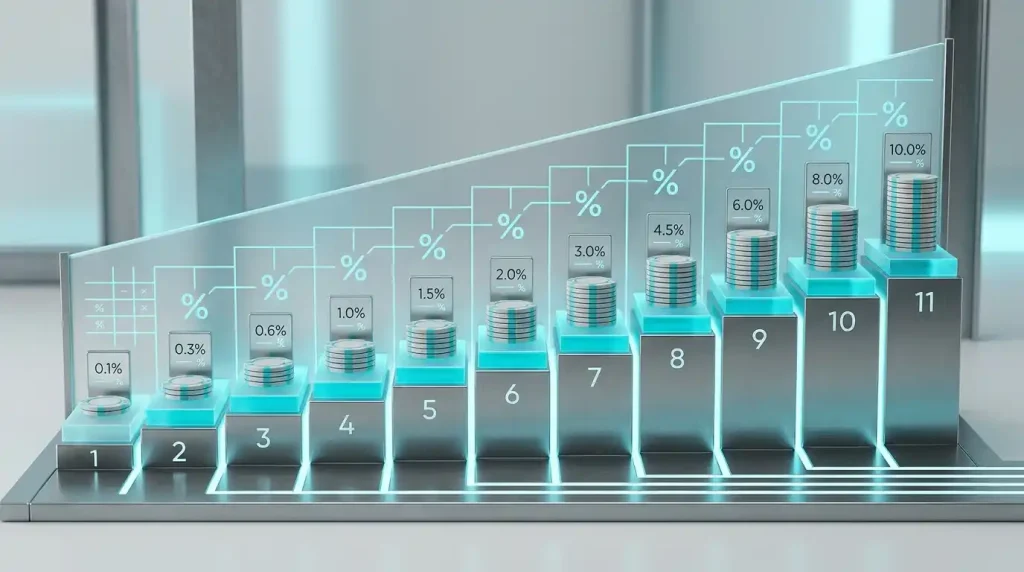
Table of Contents
- The 11-level ladder separates status progression from the cash value of rakeback
- “Up to 30%” is a ceiling whose meaning depends on the calculation base
- Measured effective rates were far below the headline percentage
- The denominator determines whether two VIP rates are genuinely comparable
- A useful VIP check starts with mechanics, not status labels
- Questions about Jackbit VIP and rakeback
- Judge Jackbit VIP by the effective return, not the 30% ceiling
Section element
Loyalty and rakeback mechanics
The VIP structure runs from Rookie to Legend across 11 levels and includes instant rakeback without an additional wagering requirement. Jackbit promotes a rate of up to 30%, yet measured effective returns were much lower in two hands-on tests. The difference is less about one figure being automatically comparable with another than about understanding what each percentage is measured against.
Section element
- VIP levels11
- Entry tierRookie
- Top tierLegend
- Headline rakebackUp to 30%
The 11-level ladder separates status progression from the cash value of rakeback
Jackbit’s VIP program has 11 levels beginning at Rookie and ending at Legend. That tells you the program has multiple progression steps, but tier count alone does not reveal the return a player receives at any one level. The practical question is what activity qualifies, what base the percentage is applied to and whether higher status materially changes the amount returned.
Progression
Eleven tiers create room for gradual movement rather than a simple member/non-member split. A tier system can affect eligibility, rate ceilings or other benefits, but the only brand-specific points that can be stated here are the level count and the Rookie-to-Legend range.
Rakeback
The program includes instant rakeback without an additional wagering requirement. That distinction matters because a returned amount that must be wagered again is economically different from a return that is credited without another playthrough condition.
Headline rate
Jackbit advertises rakeback of up to 30%. “Up to” is a ceiling, not a promise that every player or every unit of wagering receives that percentage.
Observed return
Measured effective returns were roughly 0.2–0.9% in one test and roughly 0.2–0.3% in another.
For a reader comparing loyalty value with the cost of play, the tier name is therefore secondary to the return mechanics. The Jackbit games guide gives the game-side context, while the welcome bonus guide covers a separate promotional structure that should not be mixed with ongoing rakeback.
“Up to 30%” is a ceiling whose meaning depends on the calculation base
The promotional wording is “up to 30%” rakeback. Read literally, that establishes a maximum advertised percentage. It does not by itself tell you whether the percentage applies to total wagering, theoretical house edge, net losses, eligible game contribution, points, or another internal base. Those different denominators can produce very different effective returns even when the headline percentage looks large.
Consider a neutral example that is not a Jackbit calculation. If a program returns 30% of a $10 eligible value, the cash return is $3. Another program returning 0.3% of $1,000 in wagering also produces $3. The percentages look dramatically different because they are measured against different bases. That is why headline percentage and effective return should be compared only after the denominator is clear.
The same principle applies when deciding whether loyalty value offsets ordinary gambling cost. Rakeback can reduce net loss over time, but it does not remove house edge, variance or the possibility of losing the full amount wagered.
Measured effective rates were far below the headline percentage
The two measured effective-return ranges were roughly 0.2–0.9% and roughly 0.2–0.3%. Those ranges are not identical and should remain separate. They point in the same broad direction, however: the return measured against play was materially below the advertised ceiling of up to 30%.
| Figure | Context | How to read it |
|---|---|---|
| Up to 30% | Jackbit headline claim | Maximum advertised rakeback percentage; the applicable base is essential to interpretation. |
| ~0.2–0.9% | Hands-on effective-rate report | Observed return relative to the tester’s play context. |
| ~0.2–0.3% | Separate hands-on effective-rate report | Another observed range in a different test context. |
The two measured ranges should not be averaged into a single “true” rate. Different game mixes, status levels, time windows or qualifying rules can change an effective percentage. A useful comparison therefore keeps each measured range intact and asks whether a player’s own eligible activity resembles the conditions behind either observation.
What the measured ranges can tell you
- The headline ceiling did not translate directly into the same percentage of total play in the measured results.
- Effective return is more useful than a headline when the denominator is total wagering.
- The cash result can vary by context.
What they cannot tell you
- They do not guarantee a fixed return for every tier or every player.
- They do not establish one universal rate across all games or activity.
- They do not turn rakeback into positive expected value.
The denominator determines whether two VIP rates are genuinely comparable
Rakeback marketing often compresses a multi-step formula into one number. The safest way to unpack it is to separate three layers: the activity that creates eligibility, the base value used in the calculation, and the percentage applied to that base. Only then can the result be compared with total wagering or total losses.
- Identify qualifying activity. Some games or bet types may contribute differently in loyalty systems generally, so the eligible set matters before any percentage is applied.
- Find the calculation base. A rate applied to theoretical value is not directly comparable with a rate applied to all wagering.
- Apply the percentage. “Up to” should be treated as a ceiling unless the player’s current tier and conditions clearly produce that rate.
- Convert the result to an effective return. Divide the actual cash value received by the player’s total wagering if the goal is to compare programs on the same basis.
For example, imagine a player wagers $5,000 in a month and receives $15 of loyalty value. The effective return against wagering is 0.3%, regardless of what headline percentage appeared in the promotion. That example is generic, but it shows why a normalized rate can be more informative than a marketing ceiling.
Cash movement still matters after a reward is credited. The Jackbit payments guide covers withdrawal minimums, network fees and timing observations separately from VIP mechanics.
A useful VIP check starts with mechanics, not status labels
Before increasing play to chase a higher tier, compare the extra gambling exposure with the cash value actually returned. Moving from one status label to another can feel like progress while still costing substantially more than the loyalty value received.
- Treat “up to 30%” as a maximum advertised rate, not a default return.
- Check which activity contributes to VIP progress and which base is used for rakeback.
- Compare actual cash returned with total wagering to calculate an effective percentage.
- Keep the ~0.2–0.9% and ~0.2–0.3% measured ranges separate rather than averaging them.
- Do not increase stakes simply to reach a tier or recover previous losses.
If account review affects a withdrawal, the Jackbit account guide explains the reported risk-based verification path. That process is separate from the VIP rate itself.
Questions about Jackbit VIP and rakeback
How many Jackbit VIP levels are there?
Jackbit has 11 VIP levels running from Rookie to Legend.
Does Jackbit offer rakeback?
Yes. The VIP program includes instant rakeback without a wagering requirement.
Is Jackbit rakeback really 30%?
Jackbit advertises rakeback of up to 30%, while measured effective returns were around 0.2–0.9% in one test and around 0.2–0.3% in another. The figures use different contexts and should not be collapsed into one rate.
Why can a headline rakeback percentage differ from the effective return?
A headline percentage can apply to a narrower eligible base, while an effective return is often measured against total wagering. The denominator and eligibility rules determine what the percentage means in cash terms.
Judge Jackbit VIP by the effective return, not the 30% ceiling
Jackbit has a substantial 11-level loyalty ladder and an ongoing instant rakeback feature without additional wagering. The headline reaches “up to 30%,” but the measured effective-return ranges were much lower. The useful comparison is therefore not tier name versus tier name; it is cash value received versus the activity required to earn it. Keeping the denominator visible makes the VIP program easier to evaluate without mistaking a promotional ceiling for a guaranteed percentage of total play.